
%20(4).png)


For decades, the medical equipment business followed one script: build or buy a device, sell it, invoice it, move on. The transaction ends, the operational burden shifts to the buyer, and the manufacturer or distributor goes looking for the next sale.
That script is no longer the only one being followed.
med4rent, a German eCommerce startup founded in 2023, built its entire business on the opposite premise, that medical devices should stay in circulation rather than be sold once and forgotten.
Pulse4all offers defibrillators as a subscription so that the devices are always maintained and ready to save a life.
Agiliti supplies US hospitals with infusion pumps, respiratory devices and patient-ready beds on demand instead of on invoice.
And even Philips, one of the largest medical device manufacturers in the world, now offers its patient monitoring systems through as-a-service models, including a version where Philips retains full ownership of the hardware and the hospital pays per use.
When Philips, a device manufacturer of that size, starts renting out its own products, it's fair to say that selling medical devices is not the only way to run a business.
But "not selling" isn't one model. It's at least three, rental, lease, and subscription, and they behave very differently in a medical context.
This article breaks down all four options (including buying, because that's still the benchmark everything gets compared against), who each one fits, and what each one means operationally if you're the one offering it.
Why the shift to medical device as a service is happening and why now
Before comparing models, it's worth understanding what's driving the move away from ownership. Because this isn't a trend piece; the pressure is coming from very specific places.
1. Equipment ownership has become brutally expensive to carry
The purchase price of a medical device is only the entry fee.
According to figures cited in Becker's Hospital CFO Report, hospitals spend around $93 billion per year on medical equipment lifecycle costs — everything related to purchasing, supporting and disposing of equipment — and even diligent hospitals leave savings of 12–16% of those lifecycle costs (roughly $12,000 per bed per year) on the table due to a lack of visibility and internal resources.
At the same time, R&D-driven innovation keeps pushing device prices up while shortening the window in which any given device represents the state of the art.
Owning equipment increasingly means owning depreciation, maintenance and obsolescence.
2. The people buying practices can't justify the capex
This one is very visible in the German market, where med4rent operates.
Medical practices are changing hands as an entire generation of practice owners retires, and the incoming owners face immediate investment decisions about equipment.
Many can't justify (or finance) large capital outlays for devices that will be outdated in a few years.
Layered on top of that: investors are acquiring and consolidating multiple practices, and they face the same dilemma at portfolio scale.
Continuously reinvest in new equipment for every location, or let the standard of care slide on outdated devices? Access models resolve exactly this tension — modern equipment, no capex, predictable monthly cost.
3. Perfectly functional equipment is going to waste
"Medical devices often have a shockingly short lifespan. Currently, in Europe, many medical devices end up in the trash after only a short period of use or are left unused, and new ones are purchased. We want to change that."— Michael Heine, Managing Director, med4rent
A device that's used briefly and then stored or discarded is a financial failure and an environmental one. Circular access models — where one device serves multiple customers across multiple rental cycles — turn that waste into revenue. This is the core logic behind medical device-as-a-service.
4. Demand itself is shifting toward flexible access
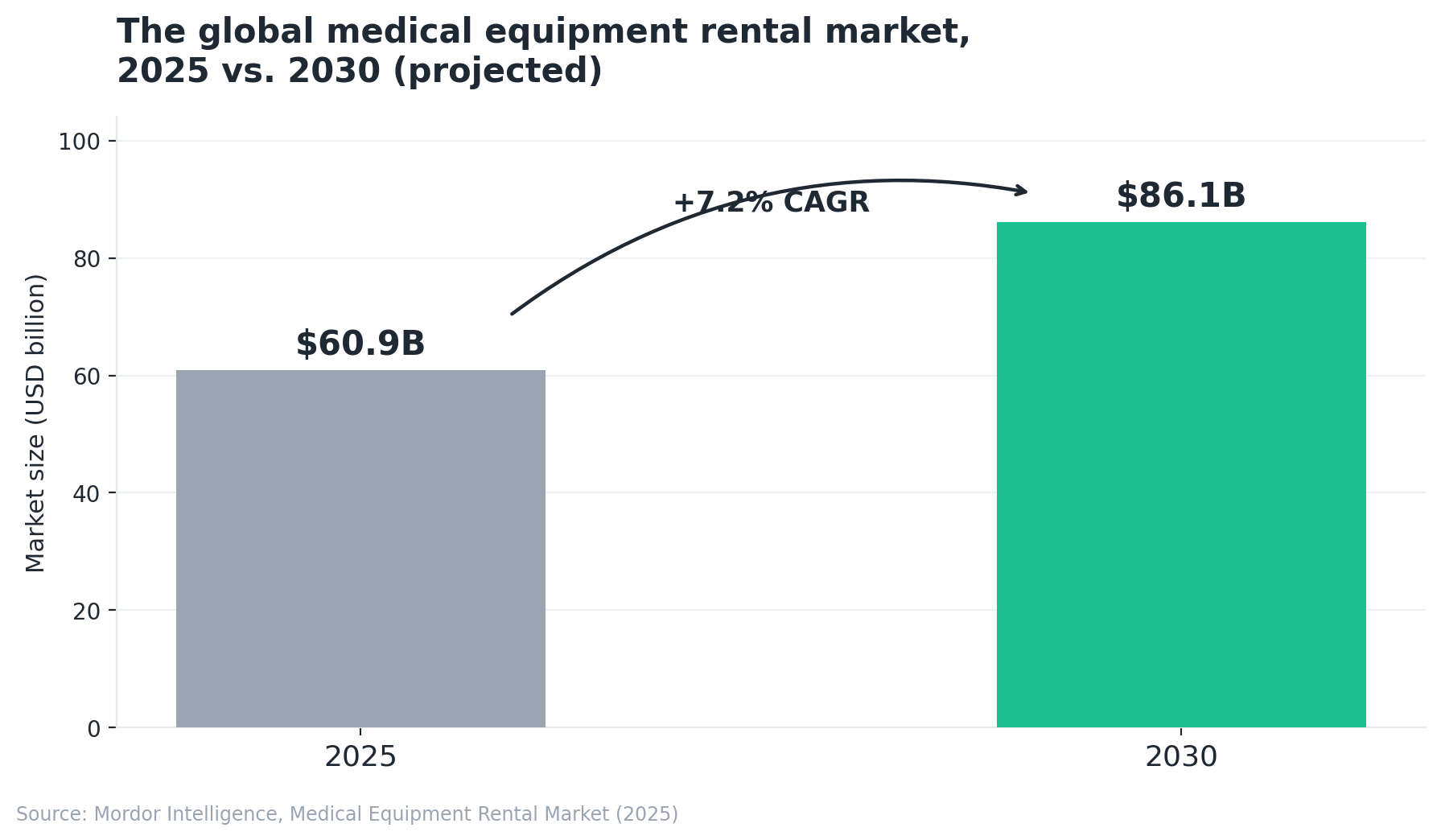
The market data backs up what the anecdotes suggest. Mordor Intelligence values the global medical equipment rental market at $60.9 billion in 2025, projected to reach $86.1 billion by 2030 (a 7.2% CAGR) — and explicitly attributes the growth to hospitals, long-term care facilities and home-care providers pivoting toward asset-light models that protect capital budgets and shorten technology refresh cycles. The Business Research Company arrives at nearly the same picture: $63.9 billion in 2025, growing to $87.5 billion by 2030.
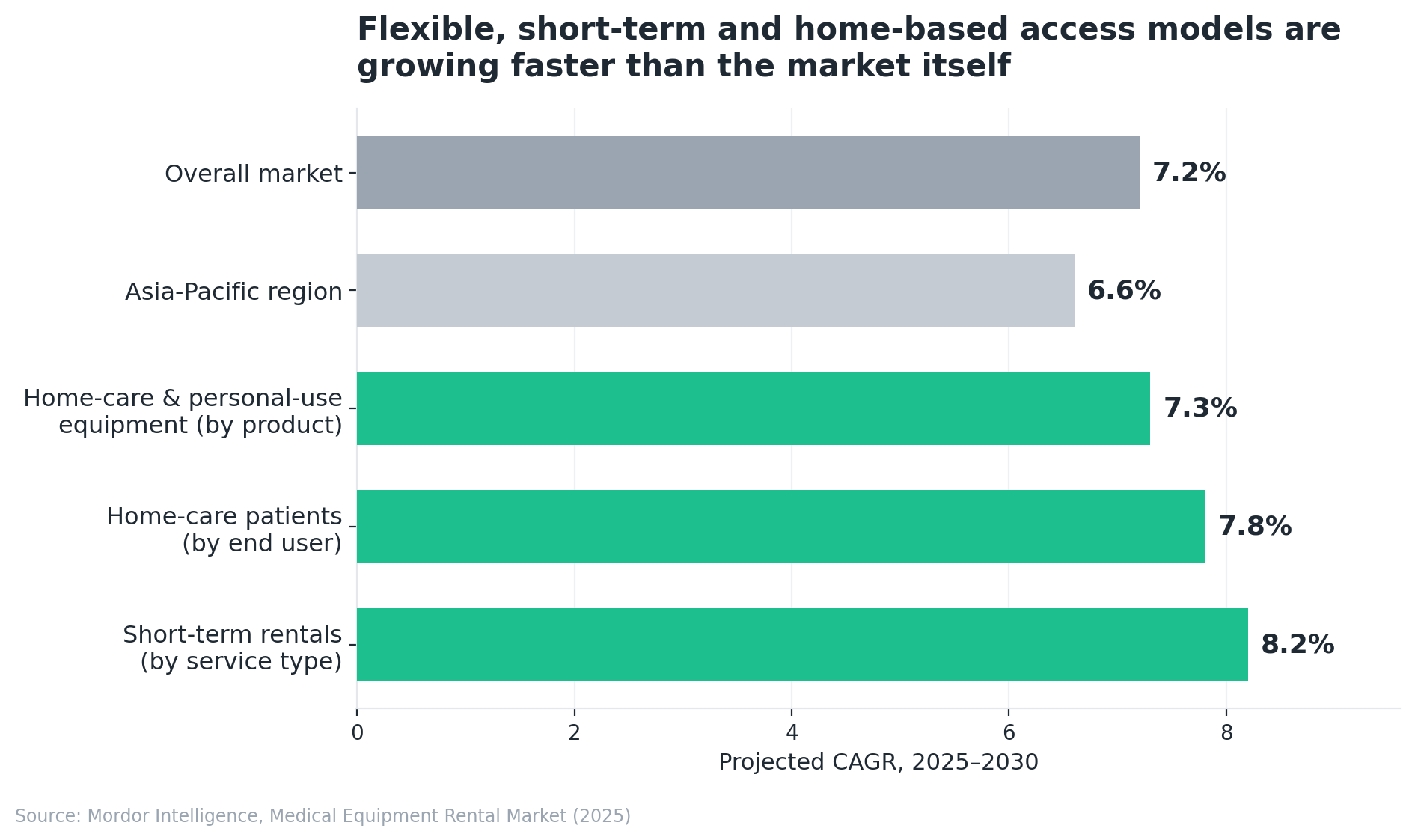
And it's the most flexible segments growing fastest: within the same Mordor Intelligence analysis, short-term rentals are projected to grow at 8.2% annually through 2030, home-care patients as an end-user group at 7.8%, and home-care equipment at 7.3% — all faster than the market overall. Europe, notably, was the largest regional market in 2024 with a 29.1% share.
So the desire to move beyond a sales-only model isn't speculative. The question for anyone holding medical equipment inventory, manufacturer, distributor, or rental entrepreneur, is not whether to offer access instead of ownership, but in which form.
Which brings us to the models.
The four models, defined for medical equipment
The terms rental, lease and subscription get used interchangeably in marketing, which creates real confusion, we've written about the general distinction between subscription, rental and lease before. In a medical context, the differences are sharper, because service, compliance and readiness-for-use are part of the product.
Buying: the benchmark
Outright purchase still makes sense in specific situations: equipment that's used constantly at full capacity, devices with very long useful lives, or cases where regulatory or hygiene constraints make shared use impractical. The buyer gets full control and full asset value — and takes on maintenance, calibration, compliance documentation, repairs, storage, and eventual disposal.
Everything below is essentially an answer to the question: what if someone else carried those burdens?
Rental: short-term access, project- or need-based
A medical equipment rental is temporary access for a defined need. A hospital covering a demand surge. A clinic bridging the repair time of its own device. A patient who needs a therapy device for eight weeks of post-operative recovery at home.
The defining traits: short duration, low commitment, and the equipment goes back when the need ends. Agiliti built a substantial business on exactly this — supplying hospitals with on-demand rentals of critical equipment so they can adapt to fluctuating demand without buying extra units outright.
For the provider, running a medical equipment rental business is the highest-velocity model: many customers cycle through each device, which means strong utilisation potential — but also constant returns, inspections, cleaning, testing and redeployment. Every return triggers a turnaround process before the device is rentable again. (If you're evaluating tooling for this, we've covered what features a medical equipment rental software needs in depth.)
Lease: long-term, structured, often with a purchase option
A lease is a fixed contract — typically 12 to 48 months — for a specific, identified asset, usually with the option to buy at the end. It's the oldest access model in healthcare: think of a hospital leasing an MRI machine over five years, paying monthly instalments, with a buyout option at term. Med One Group, for example, offers both rental and leasing to healthcare facilities for everything from ventilators to monitors.
Leasing carries significant legal and financial structure: credit checks, down payments, depreciation terms. It suits high-value, long-lifecycle equipment where the customer essentially wants ownership economics with spread-out payments. Service is sometimes included, but it's contractual, not the point of the model.
Subscription (Medical Device-as-a-Service): ongoing access with service built in
A subscription is where access models stop imitating financing and start behaving like a service. The customer pays a recurring fee for continuous access to equipment — and the fee covers more than the hardware: maintenance, technical support, replacement devices, upgrades.
This is the model med4rent runs on. Customers — from individual patients to clinics and laboratories — subscribe to devices across 34 categories on fixed contracts of up to 24 months, with setup support, technical support and a free replacement device if something malfunctions, all included. At the end of the term, a reusable return box arrives and the device goes back into circulation.
Pulse4all applies the same logic to defibrillators, where the service component isn't a convenience — it's the product. A defibrillator subscription only works if the device is always ready to use, which means asset tracking, updates and renewals are inseparable from access.
And at the enterprise end, Philips' Enterprise Monitoring as a Service offers hospitals a choice between shared-ownership subscription structures and a fully Philips-owned, pay-per-use model. The logic is identical to med4rent's, just at hospital scale: shift the burden of keeping technology current, compliant and operational to the party best equipped to carry it. If you want to go deeper into this model, we've written a full guide on how to launch a medical equipment subscription business.
A variant worth knowing: pay-per-use, where billing follows actual usage rather than time. Imagine a supply drawer in a dental practice with an IoT sensor, billing only for what's consumed. It's still niche in medical equipment, but it's the logical endpoint of the same shift — more on it in our medical device-as-a-service glossary entry.
Which model fits? Two ways to read that question
If you're the one choosing (clinic, hospital, practice, patient)
The honest answer depends on three variables: how long you need the equipment, how much service burden you can carry, and whether owning the asset ever pays off for you.
- Short, defined need (surge, repair bridge, recovery period) → rental.
- Long-term need for a specific high-value asset, and ownership would eventually make sense → lease, ideally with a buyout option.
- Ongoing need, but ownership never pays off — because technology moves too fast, because you lack biomedical/service capacity, or because capital is better deployed elsewhere → subscription.
- Maximum-utilisation equipment with a long useful life and in-house service capability → buying still wins.
The Becker's numbers are worth keeping in mind here: the 12–16% of lifecycle costs that hospitals typically fail to capture is, in effect, the price of managing equipment ownership without specialised infrastructure. Access models outsource exactly that problem.
If you're the one offering (manufacturer, distributor, rental business)
The same three models look completely different from the operator's seat:
Rental maximises per-device revenue potential but demands the heaviest operations: real-time availability, reservation management, and a disciplined return-inspect-clean-test-redeploy loop. Margins live and die on turnaround time and utilisation — which is why asset and product tracking sits at the core of every serious rental operation.
Leasing produces predictable, financing-like cash flows with light in-term operations — but it ties one asset to one customer for years, forgoing the utilisation upside of circulation, and it requires financial infrastructure (credit checks, contract management, residual value planning).
Subscription builds the most valuable thing a physical-product business can own: compounding recurring revenue. But the service promise is continuous — recurring billing cycles, renewals, swaps, replacement logistics, customer self-service — and it collapses fast when run on spreadsheets and a standard webshop. We've broken down why subscription management for physical products is its own discipline.
Here's the part most articles skip: you don't actually have to pick one. med4rent's model is a rental subscription — recurring billing, fixed terms, service included, circular returns. Philips offers lease-like shared-ownership structures and pure pay-per-use side by side. In practice, mature medical equipment providers blend models by customer segment: rentals for hospitals' surge needs, subscriptions for practices, subscribe-to-own and buyout options for customers who fall in love with a device.
What makes blending possible — or impossible — is the operational layer. Availability, asset tracking, recurring billing, contract logic, returns and refurbishment cycles all have to run through one system, or the complexity eats the margin. That's exactly the job of a medical equipment rental software: circuly runs rental, subscription and subscribe-to-own logic for medical equipment businesses like med4rent and Pulse4all on a single platform, so the model becomes a pricing decision instead of an infrastructure project.
If you're earlier in the journey, start here: how to start a medical equipment rental business or how to launch a medical equipment subscription business, depending on which side of this comparison pulled you in.
%20(5).png)
%20(3).png)




.png)

.png)


