
%20(5).png)


If you're building a business case for a medical equipment rental or subscription model — for a bank, an investor, or your own board — you need numbers, not vibes. This page collects the current market data in one place, with every figure attributed to its source.
(A note on method: market research firms use different scopes and base years, so their absolute numbers differ. We show the range rather than pretending one number is "the" market size. The direction, however, is unanimous.)
How big is the medical equipment rental market?
Current estimates for the global market cluster around $59–64 billion in 2025, growing to roughly $86–95 billion by the early 2030s:
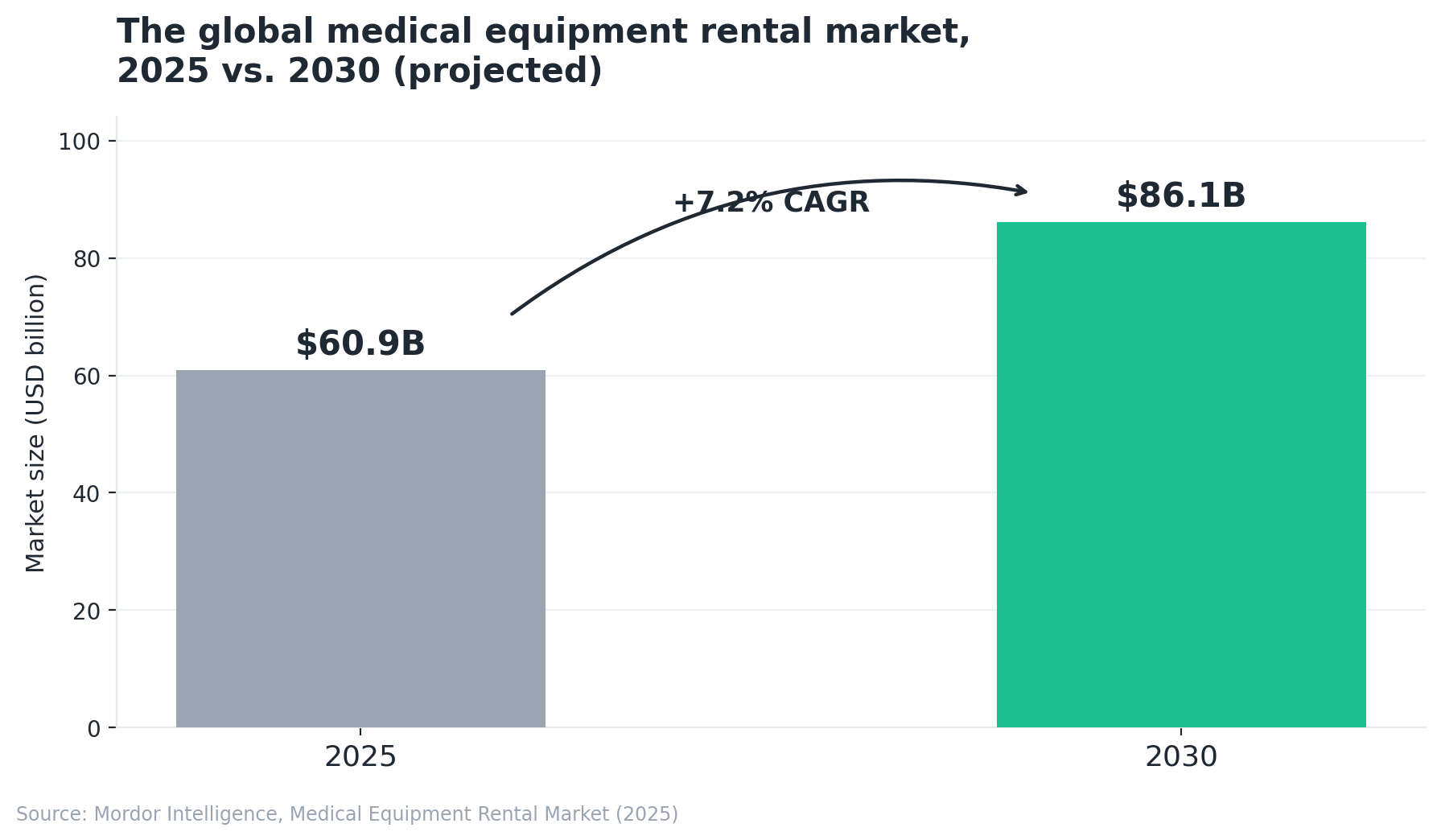
Whichever source you prefer, the shape is the same: a large market growing at a mid-single-digit to 7% annual rate, adding roughly $25–35 billion in value over the coming five to eight years.
Where the growth is coming from
The more interesting story sits inside the segments. According to Mordor Intelligence's 2025 analysis:
- Short-term rentals are the fastest-growing service type, at a projected 8.2% CAGR through 2030 (long-term rentals held the largest share, 31.7%, in 2024).
- Home-care patients are the fastest-growing end-user group at 7.8% CAGR — faster than hospitals and long-term care facilities.
- Home-care and personal-use equipment is the fastest-growing product segment at 7.3% CAGR, while durable medical equipment (DME) led all product categories with a 30.2% share in 2024.
- Hospitals and acute-care centers remain the largest end users, with 24.3% of revenue in 2024.
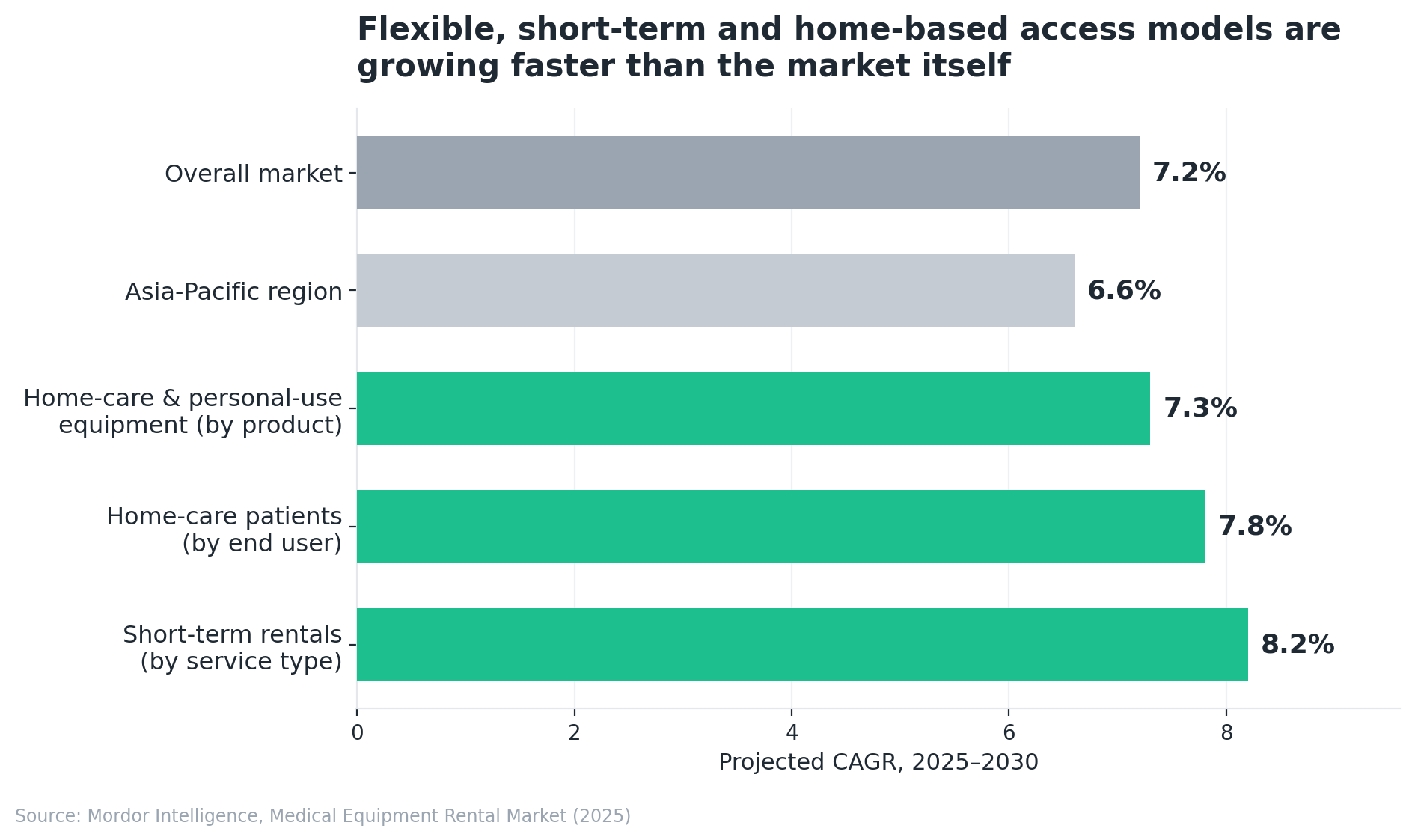
In short: the flexible end of the market — short commitments, home settings, rental and subscription access instead of ownership — is growing faster than the market itself.
Grand View Research reaches the same conclusion from its own data, projecting the personal/home-care segment as the fastest-growing end use, driven by aging populations and the rise of chronic conditions managed at home.
Regional picture
- Europe commanded the largest regional share in Mordor Intelligence's 2024 analysis at 29.1% — relevant if you're building a medical equipment rental business in the EU, where businesses like med4rent operate.
- North America is the largest region in several other analyses — Precedence Research puts its 2025 share at 33.1% — with the US market alone projected by Grand View Research to reach $20.3 billion by 2030.
- Asia-Pacific is the fastest-growing region across sources, with Mordor projecting a 6.6% regional CAGR to 2030.
The differences come down to scope (whether home-care/DME-heavy US channels are fully included), but the practical takeaway holds either way: Europe and North America are the volume; Asia-Pacific is the momentum.
What's driving the growth
Across all six research houses, the named growth drivers repeat with striking consistency:
- Capital pressure on providers. Mordor Intelligence explicitly frames the market's expansion as hospitals, long-term care facilities and home-care providers pivoting to asset-light models that cushion capital budgets, enable rapid capacity scaling and shorten technology refresh cycles. The underlying cost problem is well documented: figures cited in Becker's Hospital CFO Report put hospitals' medical equipment lifecycle costs at about $93 billion per year, with even diligent organisations missing 12–16% in potential savings.
- Technology refresh speed. Rising device prices plus faster innovation cycles make ownership a depreciation trap — renting shifts obsolescence risk to the provider.
- The home-care shift. Aging populations and chronic conditions move care (and equipment demand) into homes, where ownership makes the least sense for patients.
- Sustainability and circularity. Keeping devices in circulation across multiple users — the circular economy logic — turns equipment waste into revenue, the founding insight behind medical device-as-a-service businesses.
Who the key players are
The competitive landscape splits into two layers. Equipment providers — Mordor Intelligence names Agiliti, Baxter, US Med-Equip, Arjo and Med One Group among the market's major companies, with Straits Research adding home-care-focused players like Apria Healthcare. And manufacturers moving into as-a-service models themselves — most visibly Philips, whose Enterprise Monitoring as a Service offers hospitals subscription and pay-per-use access to patient monitoring, up to a structure where Philips retains full ownership of the hardware.
For new entrants, that second layer is the strategic signal: when OEMs start renting their own devices, access models have moved from niche to mainstream. What none of the market reports capture, but every operator learns quickly, is that competing in this market is operationally defined — recurring billing, asset tracking across circulation cycles, returns and refurbishment — which is why we've broken down the features a medical equipment rental software needs separately.
Key statistics at a glance (citable)
- Global medical equipment rental market: ~$59–64B in 2025, heading for $86–95B+ by the early 2030s (multiple sources, see table above)
- Fastest-growing service type: short-term rentals, 8.2% CAGR to 2030 (Mordor Intelligence)
- Fastest-growing end users: home-care patients, 7.8% CAGR (Mordor Intelligence)
- Largest product segment: durable medical equipment, 30.2% share in 2024 (Mordor Intelligence)
- Largest region: Europe, 29.1% share in 2024 (Mordor Intelligence); US market projected at $20.3B by 2030 (Grand View Research)
- Hospital equipment lifecycle spend: ~$93B/year, with 12–16% missed savings (Becker's Hospital CFO Report, cited via Philips)
FAQ
How fast is the medical equipment rental market growing?Between roughly 5% and 7.2% per year depending on the source and scope — with the flexible segments (short-term rentals, home care) growing at 7–8%+.
Is the medical equipment rental business profitable?The market data says demand is growing; profitability is decided operationally — utilisation, turnaround speed and contract mix. Our guide to starting a medical equipment rental business covers the unit economics side.
Which model should a new entrant offer — rental, lease or subscription?It depends on your customers and your capital; most successful providers end up blending models. Full comparison: rental vs. lease vs. subscription vs. buying.
%20(4).png)
%20(3).png)




.png)

.png)


