
swing2sleep — Making Innovative Baby Hammock Accessible Through Subscriptions
Swing2Sleep is a baby goods company founded in 2017, well before subscriptions became a mainstream topic in the kids and baby category. The company emerged from the founders’ own search for better sleep solutions for their newborn. The result was a motorised baby hammock that quickly gained popularity among young families.
As Swing2Sleep brought more and more families on board, they realised that while parents loved the concept, many hesitated to make a full purchase without knowing if the product would truly work for their baby.
With a high price point and limited period of use, the decision often required extra consideration.
To overcome this hesitation and make their innovation more accessible, swing2sleep launched a subscription model for its flagship hammocks.
By shifting from ownership to access, swing2sleep didn’t just reduce barriers for parents, it also tapped into a circular business model where products can be reused, refurbished, and re-loved by multiple families.

How the Model Works
swing2sleep designed its rental model with parents’ realities in mind: hesitation about buying an expensive product, short usage periods, and the need for flexibility. The subscription lowers the entry barrier while keeping options open, that is, whether families only need the hammock for a few months, or end up wanting to buy it permanently.
- Two product sets available for rental:
- smarla Komplettset (motor + design stand + cosy2sleep hammock with mattress)
- heia Komplettset (motor + premium stand + hammock with mattress)
- Flexible rental terms:
- heia Komplettset: subscriptions from 1–12 months.
- smarla Komplettset: subscriptions from 6–12 months.
- Buyout option: If parents decide to keep the product, up to 3 months of rental fees are credited toward the purchase price.
- No credit check required: swing2sleep removes entry barriers so parents can start renting easily.
- Return made simple: Families can send the hammock back once it’s no longer needed ensuring that products are refurbished and made available for the next family.
The core pillars behind the subscription model
Swing2Sleep’s subscription model is anchored in a series of intentional decisions, from lowering purchase risk to guiding customers toward confident ownership choices. These pillars reveal how a well-designed subscription can balance customer needs with strong business fundamentals.
#1. Subscriptions as risk reduction, not a new way of ownership
At the core of Swing2Sleep’s model is the understanding that parents are unsure whether a motorised baby hammock will work for their child.
The subscription exists primarily to:
- Lower the perceived risk of trying the product
- Avoid a large upfront purchase
- Allow parents to return the product easily if it doesn’t help
In this model, subscriptions are not positioned as a lifestyle choice or long-term alternative to buying they are a risk-free entry point.
#2. Subscribe-before-buy as a deliberate bridge
Swing2Sleep uses subscriptions as a transition mechanism, not an end state.
Key characteristics:
- Parents can rent the hammock for as little as one month
- If they decide to buy, up to three months of rental fees are credited
- Beyond three months, additional rental payments no longer count toward ownership
This creates a clearly defined decision window:
- The first three months are framed as evaluation
- After that, parents consciously choose between renting or owning
#3. Subscription as an opt-in path, not the default journey
Unlike subscription-native brands, Swing2Sleep does not force customers into subscriptions.
- Renting is not promoted directly on product pages
- The subscription option lives in the main navigation
- Customers actively choose to explore renting instead of being redirected to it
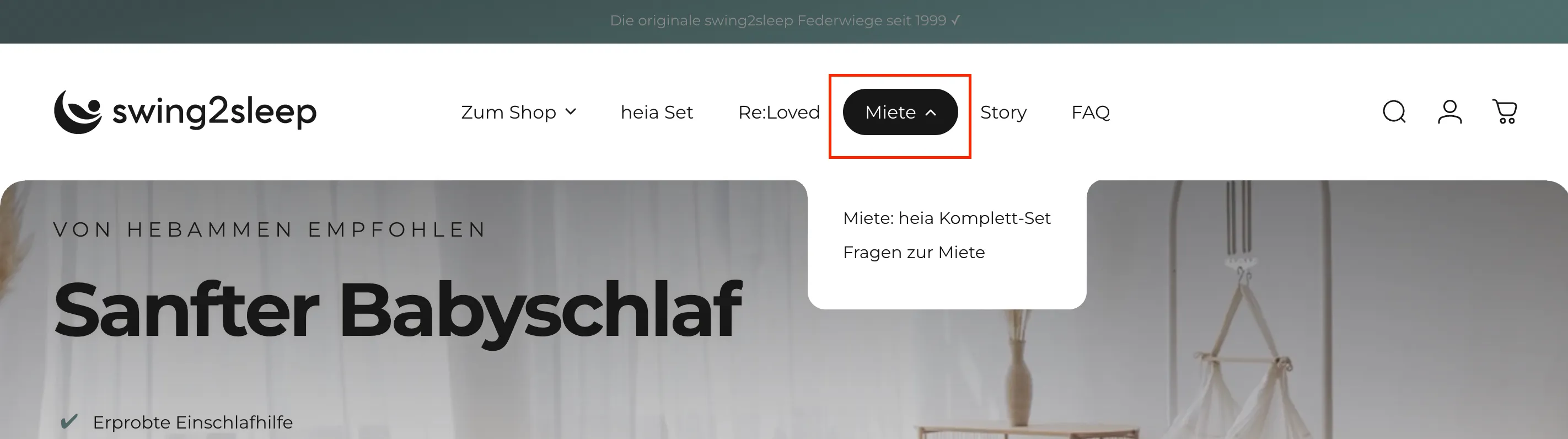
This reflects an important insight:
Swing2Sleep knows that many parents still expect to buy baby products and meets them there first.
#4. Communication focused on budget relief and flexibility
Swing2Sleep’s messaging around subscriptions is intentionally practical.
It emphasises:
- Spreading costs over time
- Fexibility in an already expensive life phase
- Using the product only as long as it’s needed
Statements like “ideal for those with a limited budget for initial equipment” and “maximum flexibility” frame the subscription as financial and emotional relief, not as a sustainability statement.
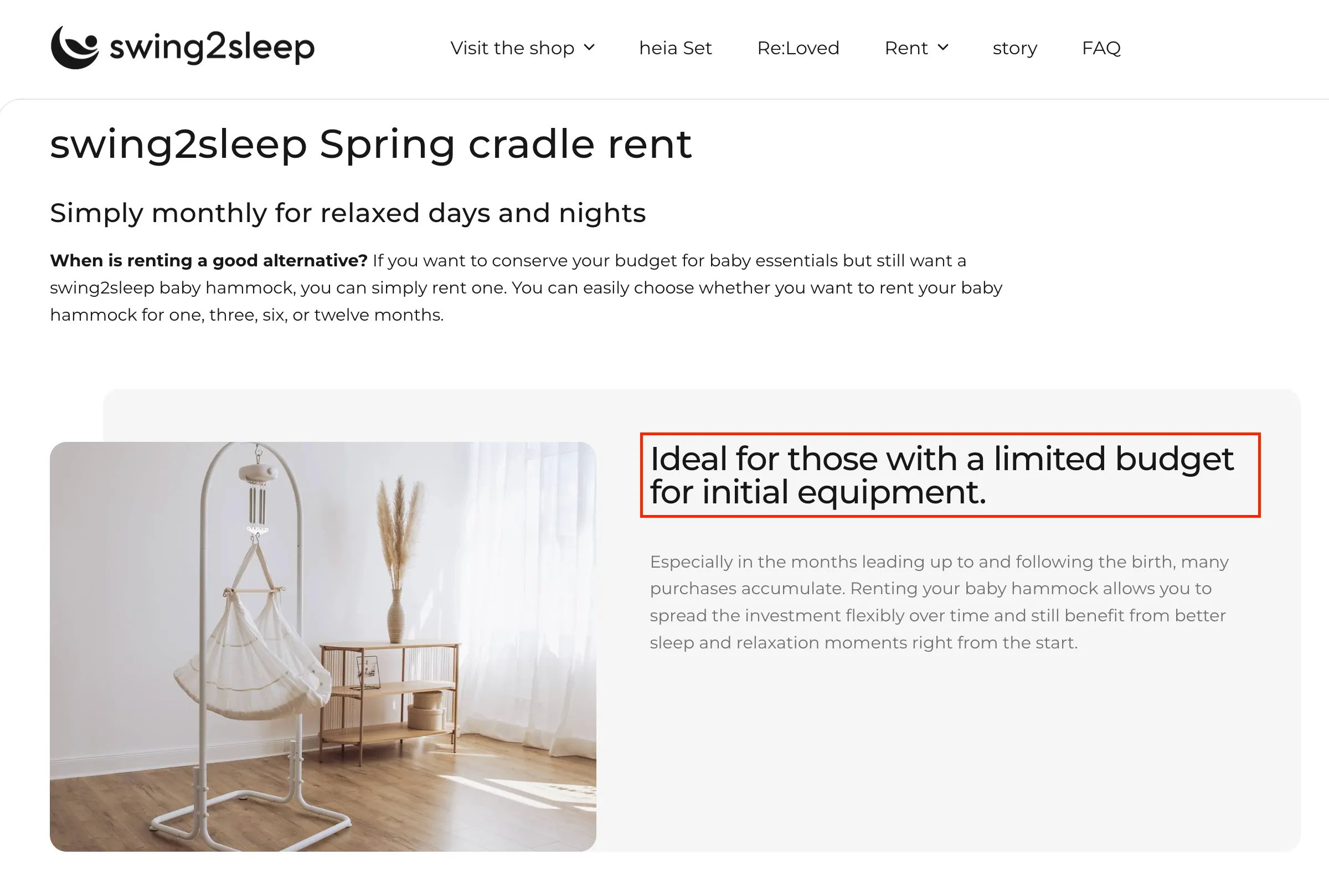
This is a clear example of aligning subscription messaging with a very specific ICP.
#5. Product-first storytelling, subscription as an enabler
Across the website, the primary focus remains on:
- The technology behind the motorised hammock
- How it works
- Why it can help babies sleep better
The subscription is presented as one way to access the product, not the defining feature of the brand.
This reinforces the idea that for some products, subscriptions are best positioned as an enabling mechanism, not a core identity.
6. Clear boundaries prevent misuse of the model
By limiting rental credit to three months, Swing2Sleep:
- Avoids indefinite “trial” behaviour
- Protects the economics of the model
- Encourages timely customer decisions
This shows a strong understanding of how subscriptions can be misused if boundaries are unclear especially when introduced into a traditionally sales-led business.
What can be learned from Swing2Sleep
Swing2Sleep demonstrates that subscriptions don’t need to mean the same thing for every business:
- Subscriptions can solve uncertainty, not just ownership inefficiency
- Subscribe-before-buy works well for high-risk, high-consideration products
- Clear decision windows protect both customer and business interests
- ICP alignment matters more than following subscription trends
- Focus beats universality don’t try to be circular, flexible, and premium all at once
For established baby goods brands, Swing2Sleep is a strong example of how subscriptions can be added strategically and selectively without redefining the entire business.
Operations where circuly Supports swing2sleep
circuly is the subscription management system behind swing2sleep, automating the core infrastructure needed to run a subscription-based business model for physical products such as kids' equipment subscriptions. Out-of-the-box, circuly handles subscription management, recurring billing and invoicing, asset tracking, product lifecycle management, return management, a customer self-service portal, transactional communication, and fraud prevention through credit checks — allowing swing2sleep team to focus on growth rather than manual admin.
Conclusion
swing2sleep demonstrates how a premium, tech-driven baby product can thrive in a subscription model. By aligning their offering with the needs of hesitant but curious parents, they’ve opened up new customer segments while keeping operations lean with circuly. This case shows that even highly personal, short-use products like baby hammocks can benefit from the product-as-a-service model combining affordability, accessibility, and scalability.
.webp)
.png)
.png)
.png)

%2520(1).png)