circuly vs. Supercycle

Which Shopify rental app is right for your circular commerce business?

Quick verdict

Both Supercycle and circuly are Shopify apps built specifically for circular commerce — rental, subscription-until-returned, and resale. This is the most direct comparison on this list: two purpose-built rental platforms, with different strengths in compliance, integrations, and geography.

Supercycle is a UK-based circular commerce platform supporting calendar-based rental, subscription-until-returned, membership access to a catalogue, and resale of used products.

Pricing: Super plan from $100/month + 1% of circular revenue. Superest plan at $500/month + 1%, adding API access and a dedicated Slack channel.

circuly Subscription & Rental app for Shopify is built for businesses with physical and consumer durable products that operate a subscription, rental or lease model for those products. circuly is built around core features like asset tracking, return management, buy-out flows.

Pricing: Free to install & run up to 25 subscriptions. Paid plans start from $90/month up to $499/month. Free trial available for all tiers.

Both platforms take serialized inventory and rental operations seriously. The practical differences show up in EU VAT/invoicing, Klaviyo integration, and where each company is legally based.

This guide is written for merchants who sell physical products on Shopify and want an honest picture of where each platform fits, and where each one falls short when it comes to operating a rental or circular commerce business model. Supercycle is the closest competitor to circuly in go-to-market — both are purpose-built for rental rather than general subscription commerce — so this comparison focuses on the operational and compliance details that actually differ.

Who each app is built for

Before comparing features, let's first understand the fundamental difference in what these two apps were designed to do.

circuly is primarily built for:

  • Bikes, e-bikes & scooters
  • Baby & kids' goods
  • Consumer electronics & appliances
  • Medical equipment & devices
  • Furniture & home goods
  • Sports & fitness equipment
  • Any product that ships, gets used, and returns
  • Brands running rentals, PaaS, subscribe-to-own
  • Try-before-buy models
  • Businesses with physical asset inventory to manage
circuly can also be used for:

  • Consumable & replenishment subscription
  • Subscription boxes and bundles
  • Subscribe-to-own or try-before-buy
  • Membership subscriptions
  • Digital & service subscriptions

Supercycle is primarily built for:

  • Calendar-based rental — items rented between two fixed dates
  • Subscription-until-returned billing
  • Membership access to a catalogue of items
  • Resale of used/returned products
  • Merchants needing serialized inventory tracking
  • Brands with a retail/POS component alongside online rental

Feature comparison: Supercycle vs. circuly

Feature circuly Supercycle Notes
Foundation
Shopify App StoreBoth install directly from the Shopify App Store
Native Shopify CheckoutNo checkout workarounds on either platform
Shopify Customer AccountsBoth integrate with native Shopify customer accounts
Shopify POS~Supercycle explicitly supports Shopify POS — a genuine edge for retail-plus-online merchants
Admin UI extensionsManage subscriptions in Shopify admin
Subscription Types
Standard / consumable subscriptions~Not Supercycle's focus — built around rental, not replenishment
Physical / rental✓ Purpose-built✓ Purpose-builtBoth platforms are built around this model
Serialized inventoryBoth track individual items by serial
Resale of used products~✓ NativeSupercycle has a dedicated resale model; circuly focuses on subscription/rental/buy-out
Subscribe-to-own~Not an explicitly named Supercycle flow
Layered / combined models✓ Explicit strengthSupercycle markets running multiple models simultaneously
Billing & Pricing
Automated billingCore feature on both
Billing intervals✓ Daily–yearly~Not publicly specified for Supercycle
Charges for extensions/damagesBoth support charging beyond the base rental fee
Discounts~Not explicitly documented for Supercycle
PDF invoices✓ Auto, VAT-compliantNot a listed Supercycle feature
Physical Product Operations
Serial tracking✓ Full lifecycle✓ Location, movement & conditionBoth are strong here — Supercycle names this as a core capability
Deposits / pre-authorization~✓ ID checks, deposits, pre-auth cardsSupercycle names this explicitly; circuly supports credit checks for high-value rentals
Return workflowsBoth support item returns as part of the rental cycle
3PL / fulfillment integrations~Supercycle lists 3PL and Patchworks integrations explicitly
Customer Experience
Customer portal~Not explicitly detailed in Supercycle's public listing
Pause / cancel~Not explicitly documented
Buy-out~Not an explicitly named Supercycle flow, though resale is adjacent
Return initiation~Not explicitly documented
Analytics & Reporting
MRR / revenue dashboard~Not explicitly documented for Supercycle
Integrations
KlaviyoNot listed among Supercycle's integrations
ERP~ Via PatchworksSupercycle connects to ERPs indirectly through Patchworks rather than a direct integration
Payments✓ Stripe & others✓ StripeBoth support Stripe
API access✓ Superest plan onlyGated to Supercycle's higher tier
Compliance
EU VATSupercycle is UK-based (post-Brexit) — not an EU VAT-native platform
Developer HQBielefeld, Germany (EU)London, UKRelevant if EU VAT compliance and EU legal context matter to your operations

circuly on Shopify

circuly is now a native Shopify app

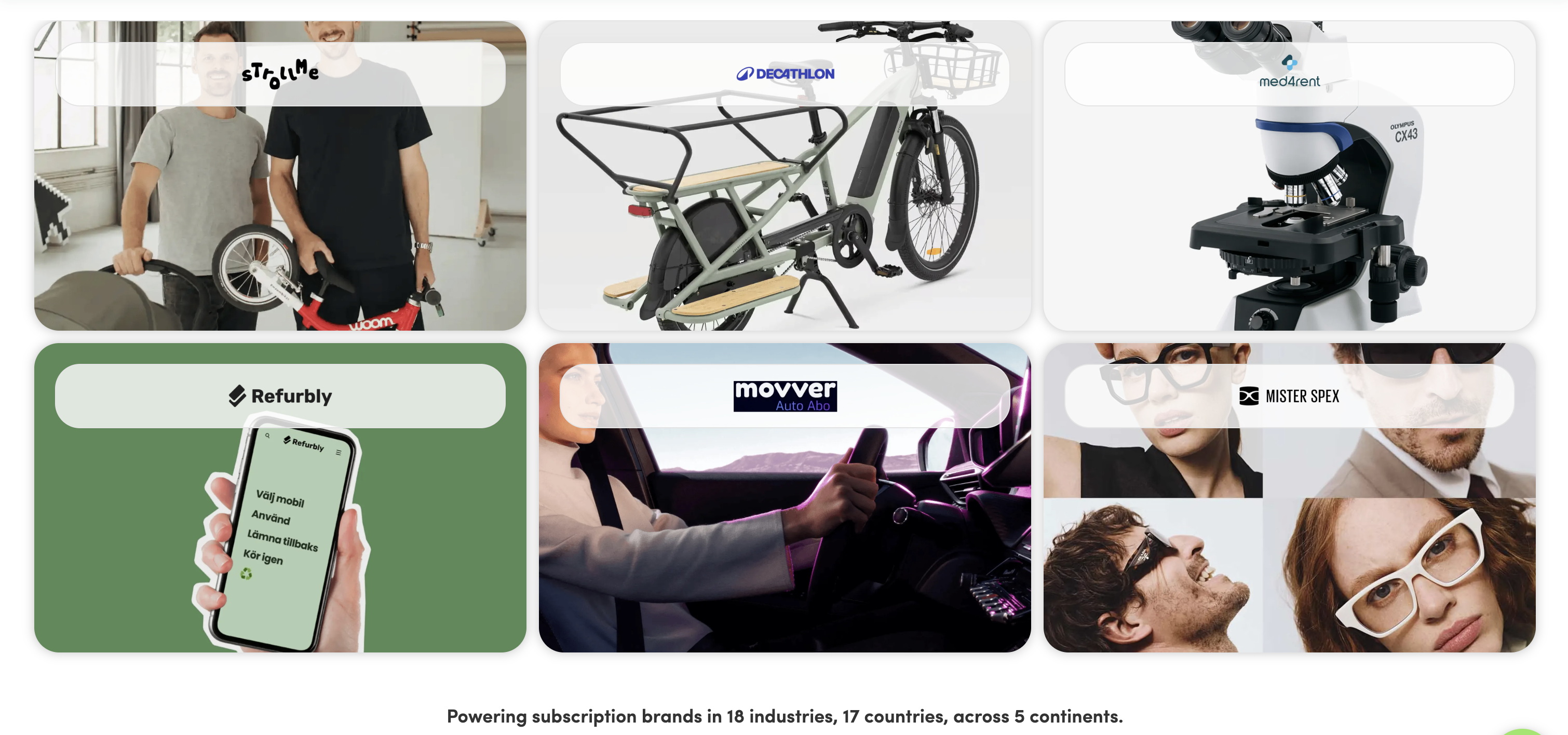
circuly has operated as a subscription management platform for physical product businesses for several years, building an enterprise customer base across Europe. Brands like Bike Club, Yuno, and StrollMe have used circuly to scale complex physical product subscription operations.

In 2025, circuly brought that operational depth directly into Shopify with a native app, available on the Shopify App Store, built around Shopify's native checkout, customer accounts, and theme architecture. Shopify merchants can now access circuly's physical product subscription infrastructure without leaving the Shopify ecosystem they've already built around.

For a Shopify merchant, this means:

  • Install circuly directly from the Shopify App Store — no custom builds or external platform required
  • Add subscription options to product pages via native Shopify theme blocks — no code needed
  • Customers check out through the standard Shopify checkout, including Shop Pay
  • Subscriber management sits within Shopify customer accounts — familiar to your team and your customers
  • All of circuly's physical product operational capabilities — asset tracking, buy-outs, returns, invoicing — available through the same Shopify admin your team already uses
  • Connect to the broader Shopify app ecosystem, including Klaviyo and ERP tools, without fragmented data

Pricing comparison: What to expect from each platform

Both platforms combine a monthly base fee with a percentage of relevant revenue. Here's the honest summary:

#1. circuly

  • Getting started: Free to install.
  • As you scale: Paid plans start from $90/month up to $499/month; custom pricing available for larger operations
  • Transaction fee: A commission applies on subscription revenue — decreases as you move up plans
  • Free trial: 14-day free trial available on paid plans

#2. Supercycle

  • Getting started (Super): $100/month + 1% of circular revenue
  • As you scale (Superest): $500/month + 1% of circular revenue — adds API access and a dedicated Slack support channel
  • Free trial: 14-day free trial on both tiers; free on Shopify development stores

9. Final Verdict

✓ Choose circuly if...

  • You rent, lease, or lend a physical product on subscription
  • You need to track individual units by serial number
  • You want to bundle consumable or digital add-ons with a hardware subscription
  • You offer or want to offer subscribe-to-own or try-before-buy
  • You need legal PDF invoicing with EU VAT support
  • You're renting high-value items and need fraud prevention at checkout
  • You have rental contracts with minimum commitment periods
  • You want to validate your model before committing to a paid plan
  • You want all of this inside your existing Shopify store

• Choose Supercycle if...

  • Resale of used/returned products is a core part of your model, not just rental
  • You run a hybrid retail + online rental business and need native Shopify POS support
  • You need 3PL or Patchworks-based fulfillment integrations out of the box
  • You're not EU-based and EU VAT compliance isn't a requirement
  • You want to run rental, subscription, membership, and resale models simultaneously on one platform

This is the closest matchup on this list — both platforms are purpose-built for circular commerce, not general subscription billing. Supercycle has a broader circular-commerce scope (rental, membership, and resale together) and native Shopify POS support. circuly has the edge on EU VAT-compliant invoicing, Klaviyo integration, and being built and based in the EU. If resale and in-store retail are core to your business, Supercycle's scope is worth a close look. If EU compliance, invoicing, and marketing-stack integration matter more than resale, circuly is the more complete fit.

Can circuly handle consumable subscriptions, or is it only for rentals?
Does circuly's Shopify app work with native Shopify Checkout?
What does circuly offer that Recharge doesn't, for physical product businesses?
Can I run a subscribe-to-own or try-before-buy model through the circuly Shopify app?
How does circuly handle pricing?
Is circuly suitable for European Shopify merchants?

FAQs about

circuly vs. Supercycle

Can circuly handle consumable subscriptions, or is it only for rentals?
Does circuly's Shopify app work with native Shopify Checkout?
What does circuly offer that Recharge doesn't, for physical product businesses?
Can I run a subscribe-to-own or try-before-buy model through the circuly Shopify app?
How does circuly handle pricing?
Is circuly suitable for European Shopify merchants?