
#toc a { text-decoration: none !important; border: none; background: transparent; padding: 10px; display: block; line-height: 1.2; border-radius: 4px; transition: all 300ms; color: #6b7280; font-family: "Sofia Pro", sans-serif; font-weight: 400; } #toc { font-size: 16px; margin-bottom: 0; } #toc li { padding: 2px 0; } #toc ul { list-style: none; margin: 0 !important; padding: 0; } #toc a.active, #toc a:hover { background: #cffce9; } /* Optional: make active item stand out more */ #toc a.active { color: #000000; font-weight: 500; }

Shopify Product as a Service eCommerce Integration: The Complete Guide to Running Subscriptions on Shopify

Shopify has plenty of subscription apps. Almost none of them were built for Product-as-a-Service. Here's why, what the gap looks like, and what you actually need to run a physical product subscription on Shopify.
Garima Singh
Product Marketing Manager @ circuly
TABLE OF CONTENT

Shopify is one of the most widely used eCommerce platforms on the planet, dominant in online retail and the default choice for a huge portion of merchants, from first-time founders to established brands.

In fact, Shopify now powers 26% of all ecommerce websites globally and holds around 29% of the US ecommerce market (source).

Over the past decade or so, many industries have gradually shifted towards subscription models, incorporating recurring revenue on top of their existing sales-based operations on Shopify.

The subscription economy has grown fast, valued at $492 billion in 2024 and projected to reach $1.5 trillion by 2033, growing at a CAGR of 13.3% (Grand View Research). Subscription-based businesses have seen 435% growth over the past ten years (Swell), and a significant chunk of that growth has happened on Shopify.

But not all subscription models are the same.

Broadly speaking, subscriptions in eCommerce have developed across a few distinct types:

  • There's subscribe-and-save that is consumables sent on a recurring schedule.
  • There's curated box subscriptions meaning a new selection every month.
  • There are memberships and access subscriptions.
  • Product-as-a-Service (PaaS), where a physical, durable product is rented or subscribed to, used, returned, and eventually sent out to the next customer.

That last one, consumer durable subscriptions and rentals, is growing but has always made up a relatively small slice of the overall subscription landscape compared to the others.
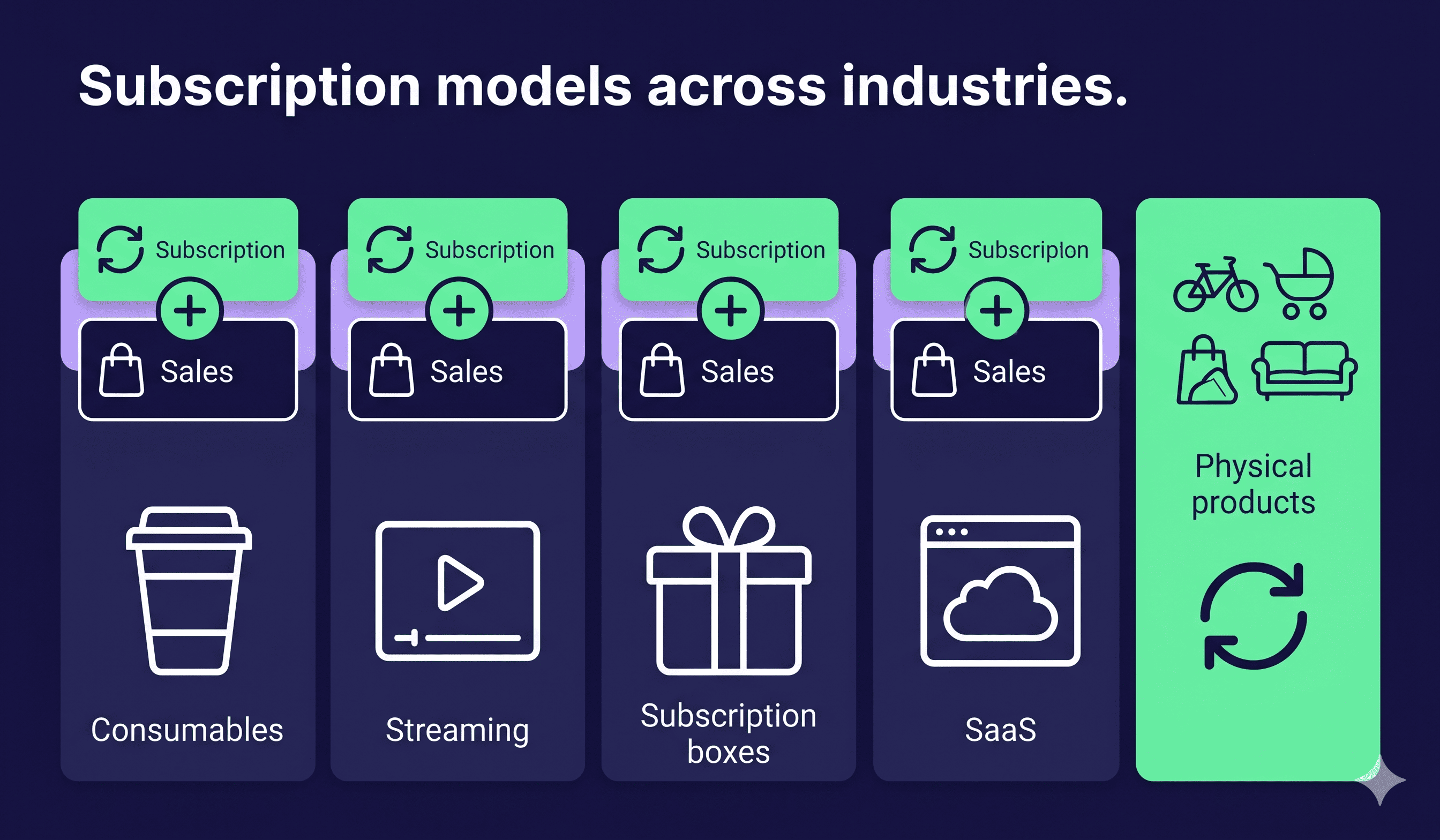
And that imbalance has shaped everything about how solutions have developed, including what Shopify supports, and what it doesn't, as well as how third-party apps and solutions have evolved.

How Shopify responded to subscriptions

As subscription commerce grew, Shopify responded by building a native subscription solution, the Subscriptions API, that lets merchants offer recurring purchases at checkout.

Customers subscribe, get charged on a schedule, and manage their subscription from their account. For straightforward subscription models, this works and is a reasonable foundation.

But it has limits.

There's no built-in support for pausing or skipping, dunning is basic at best, and customer self-service is limited without significant custom development.

And that's fine, because from Shopify's perspective, there's no reason to build a solution for every subscription use case and business model.

So Shopify did what it does well: it opened the door to third-party developers. The Subscriptions API gave app developers the infrastructure to build on top of, and the ecosystem took it from there.

Subscription app ecosystem on Shopify - But built for the common subscription models

The Shopify subscription app market is mature now, with Recharge, Bold, Seal, Appstle and Loop among the dozens of options available. Many of them are genuinely good at what they do.

The thing is, they built for the models that had the most merchants asking.

For a long time, and still today, that was subscribe-and-save and consumable replenishment: coffee subscriptions, supplement refills, pet food on autopilot.

That's where the volume of Shopify subscription merchants was concentrated, so that's where development effort went.
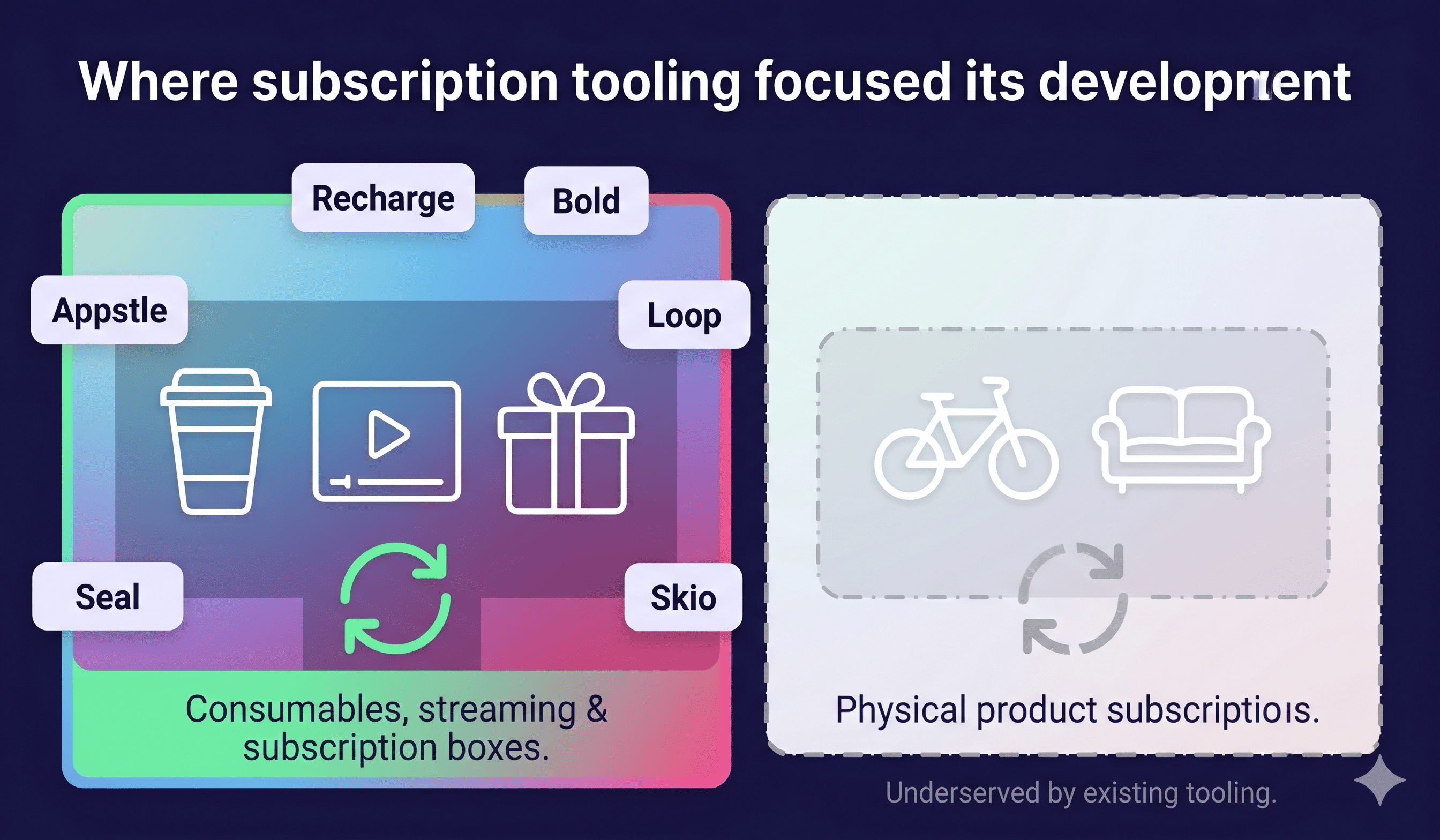
The core assumption built into most of these apps is simple: the product ships and doesn't come back. It gets consumed, a new one ships next month, and the subscription is really just an automated billing and fulfilment arrangement. That assumption works fine for consumables but falls apart completely for physical durable products.

PaaS models is a different problem entirely

Product-as-a-Service is the model where a customer subscribes to access a physical product, whether that's a bike, a pram, a piece of furniture, or a medical device, pays a recurring fee, uses the product, and eventually returns, buys, or swaps it for another.

The business retains ownership throughout, the product comes back, gets refurbished, and goes out to the next subscriber.

It's a real and growing category, but it has always been a smaller segment than consumable subscriptions, with fewer merchants, noisier operational complexity, and a less standardised playbook.

So while the Shopify subscription ecosystem grew and matured, PaaS largely got left behind — not because nobody needed it, but because the demand wasn't loud enough yet to pull serious development effort toward it.

The result is a meaningful gap between what the Shopify app ecosystem offers and what a physical product subscription business actually needs.

What makes PaaS operationally different

Standard subscription apps weren't built for the problems PaaS creates. Here's what running a physical product subscription actually requires that a billing-focused app doesn't handle.

  • Individual asset tracking. Not just inventory count, but which specific unit is with which customer, by serial number, including its condition, its history, and when its contract ends. You need to know that bike number 47 is currently with a subscriber in Hamburg, their term ends on the 15th, and it came back last time with a cracked mudguard.
  • Return management. When a subscription ends, the product needs to come back, which means triggering return logistics, generating a return label, and communicating the return process to the customer. None of this is a standard subscription app feature.
  • Refurbishment tracking. After return, the product goes through inspection, cleaning, and repair if needed, and it needs to be tracked through that process and only cleared for redeployment when it's ready.
  • Recurring billing for physical products. This is more nuanced than it sounds. If a customer's payment fails, a standard dunning flow treats it like a digital subscription, sends a reminder, retries, then cancels. But for a physical product subscription, the product is still with the customer when that happens, so the recovery logic, the communication, and the operational response are all different.
  • Customer self-service. A subscriber needs to be able to pause, request a return, or ask about extending their term without calling support. The self-service layer for physical product subscriptions is different from a consumable subscriber managing their next delivery date.

Standard Shopify subscription apps weren't designed with any of this in mind because they solved a different problem. That's not a criticism of those tools, just a statement about scope.

Integrations: A huge topic, but here's what PaaS need as a core

Integrations for a physical product subscription business aren't one question, they're many.

Depending on how you want to operate, you might need:

  • A document-signing integration so customers sign a contract digitally before the product ships.
  • Or an identity verification tool for high-value items.
  • Or a field-service integration for on-site delivery and installation.
  • Every business makes its own decisions about how to handle these things, and the integration list expands accordingly.

But those are business-specific decisions. What applies to nearly every physical product subscription business running on Shopify is the core operational layer, and that's where the real gap exists.

#1. Order placement and mixed baskets

In PaaS, a customer might want to order a physical subscription product alongside a one-time accessory or a consumable add-on, expecting one checkout, one invoice, and one delivery.

On Shopify, mixing subscription types and one-off purchases in a single cart creates complications: separate orders, double shipping charges, and inconsistent checkout logic.

It's a known limitation that merchants work around, but it's a friction point from day one.

#2. Recurring billing with flexibility

At the surface level, recurring billing looks simple, charge a set amount on a schedule.

But physical product subscriptions need to modify active contracts mid-cycle, and most billing tools weren't designed for that.

For example:

  • A customer's product arrives two days late, the billing start date needs to shift.
  • A customer wants to extend from a 3-month to a 6-month term.
  • A goodwill gesture is needed after a damaged delivery.
  • A winter retention campaign means temporarily lowering the monthly fee to reduce churn, then returning to the standard price come spring.

All of this needs to happen without cancelling and recreating the subscription as it is the same customerm the same product, the same contract, the billing logic just needs to flex. Most Shopify billing apps handle none of this.

#3. Renewals and extensions

Fixed-term subscriptions raise a question at end of term: return the product, extend the subscription, or buy it out?

A well-run PaaS business handles this automatically.

The customer gets notified before their term ends. They're offered a renewal, often at a lower rate to reward loyalty. If they don't respond, a return workflow triggers. If they want to keep the product, a buyout price is presented.

Shopify's native tools don't orchestrate this. Neither do most App Store subscription apps.

#4. Payment retries and dunning

Payment failures happen because cards expire, banks decline charges., customers switch accounts. In a long-term physical product subscription, this is an ongoing operational reality, not an edge case.

You need automatic retry logic that attempts the payment multiple times on a defined schedule, sends automated customer notifications, and escalates appropriately when retries fail.

The catch with physical products: when a payment fails, you still have a product in the customer's possession. Your dunning logic has to account for that. The recovery approach is different from chasing a Netflix payment.

#5. Debt collection

When retries fail and the customer goes quiet, the next step is structured debt collection — either handled internally or through a third-party partner. This is especially true for high-value items. A €800 e-bike sitting with an unresponsive subscriber is not the same problem as a lapsed streaming subscription. The operational response needs to match.

#6. Identity and credit checks

Because you're handing over a physical product — often an expensive one — it's common to verify customer identity or creditworthiness before shipping. The method varies by category and risk profile: soft credit checks at checkout, payment method validation, ID verification at point of collection. You decide the approach based on your product value and customer base. But the integration needs to be there.

7. Asset tracking

You still own the product while it's with the customer. That means you need to know exactly where each unit is at all times — not just as a stock count, but at the individual asset level.

Serial number. Current subscriber. Subscription start and end date. Repair history. Revenue generated per unit. Condition on last return. This data doesn't just keep operations tidy — it tells you which assets are performing, which have been mishandled, and when each product reaches the end of its viable service life.

When a customer receives a swap or upgrade, the asset record needs to update. When a product comes back damaged, the asset history tells you who had it and when.

Standard Shopify inventory management doesn't work at this level.

8. Return management

When a subscription ends, the product needs to come back. This should be automatic: the system detects that a subscription term has ended, triggers customer communication, monitors return status, and continues billing until the product is confirmed received.

If the product isn't returned on time, the subscription keeps running — with clear customer communication about why. If it is returned, billing stops and the asset moves to refurbishment.

None of this is a standard Shopify feature. None of it is handled by a typical subscription app either.

Why the gap exists and why it's starting to close

The honest answer is that PaaS at scale in eCommerce is relatively recent. The category has been growing across e-bikes, baby gear, consumer electronics, furniture, and mobility, but it hasn't historically been as large or as vocal a merchant segment as subscribe-and-save. App developers build for demand, and demand was elsewhere.

That's changing. The circular economy is moving from a sustainability talking point to a commercial reality, and more brands are launching rental and subscription programmes for physical products. Shopify merchants are looking for solutions and finding that the existing app ecosystem doesn't quite fit.

circuly is purpose-built for physical product subscriptions and rentals on Shopify, and it covers two levels of operational scope depending on what your business needs.

For merchants who want to stay within the Shopify ecosystem, circuly offers a Shopify app that handles the core subscription operations: recurring billing, subscription management, asset tracking, and return workflows. It's a strong fit for merchants running relatively straightforward physical product subscription businesses who want a solution that sits natively within Shopify.

For businesses with more complex or custom operations, there's the circuly Hub. This is where the deeper integrations come in: connecting your accounting system so it updates on an automated schedule, integrating with your ERP, or wiring up your logistics tools to run in sync with subscription lifecycle events. Not every subscription business needs those connections, but for the ones that do, the Hub is built to support that level of operational complexity.

Which solution is right depends on the scope of your operation, but circuly covers both ends of that spectrum.

The bottom line

Shopify is a strong foundation for a PaaS eCommerce business. The storefront, the checkout, the marketing tools — all solid.

But don't go looking for your PaaS solution in the Shopify App Store expecting to find a dozen great options. The ecosystem was built for other subscription models first. PaaS is underrepresented, and most tools that claim to support it were built for simpler billing patterns and adapted at the edges.

What you need is a platform built from the ground up for physical products that come back. That means flexible billing that can modify live contracts. Asset tracking at the serial number level. Return workflows that trigger automatically. Dunning logic that accounts for a physical product in the field. And all of it connected to Shopify — not replacing it.

That's a different thing entirely from a standard subscription app.

Frequently asked questions

What does PaaS mean in eCommerce?

In eCommerce, PaaS stands for Product-as-a-Service, a business model where customers pay a recurring fee to access a physical product rather than buying it outright. The business retains ownership of the product throughout. At the end of the subscription or rental term, the product is returned, refurbished, and redeployed to the next customer. Common examples include e-bike subscriptions, baby gear rentals, furniture subscriptions, and medical equipment leases.

Does Shopify support Product-as-a-Service?

Shopify supports the storefront and checkout layer of a PaaS business through its Subscriptions API, but it does not natively support the operational requirements of physical product subscriptions. Asset tracking at the individual unit level, return management, refurbishment workflows, and mid-cycle billing modifications all require additional tooling beyond what Shopify or its standard subscription apps provide.

What is the difference between a PaaS subscription and a regular eCommerce subscription?

A regular eCommerce subscription, such as a subscribe-and-save model, involves a product that ships and is consumed. The subscription is essentially a billing and fulfilment arrangement, and the product does not come back. A PaaS subscription involves a durable physical product that the customer uses and then returns. The business owns the product throughout, which creates a completely different set of operational requirements: asset tracking, return logistics, refurbishment, and lifecycle management across multiple subscribers.

Can I use Recharge, Bold, or other Shopify subscription apps for a physical product subscription?

Most Shopify subscription apps including Recharge and Bold were built for consumable replenishment models where the product ships and doesn't return. They handle recurring billing well but do not manage individual asset tracking, return workflows, refurbishment status, or the kind of flexible mid-cycle billing modifications that physical product subscriptions require. They can work for simple physical product scenarios but fall short for most PaaS operations.

What integrations does a physical product subscription business need on Shopify?

The core requirements are: a subscription management platform that handles contracts, asset tracking, and return workflows; a payment service provider with robust recurring billing and dunning logic; and logistics integration for both outbound delivery and inbound returns. Depending on your operation, you may also need document signing for contracts, identity or credit checks before shipping high-value products, and connections to ERP or accounting systems.

What is the difference between circuly's Shopify app and circuly Hub?

circuly offers two solutions for physical product subscriptions. The Shopify app is for merchants who want to stay within the Shopify ecosystem and covers the core subscription operations including recurring billing, asset tracking, subscription management, and return workflows. The circuly Hub is for businesses with more complex or custom requirements, where deeper integrations are needed such as automated accounting system updates, ERP connections, or logistics tools that sync with subscription lifecycle events. Which solution is right depends on the scope of your operation.

Why are there so few Shopify apps built for Product-as-a-Service?

Because PaaS has historically been a smaller segment of subscription eCommerce compared to consumable replenishment or curated box models. App developers build for the highest-volume merchant demand, and that demand was concentrated in subscribe-and-save and similar models. PaaS is growing as the circular economy gains commercial traction, and purpose-built solutions are emerging, but the Shopify app ecosystem still reflects the original demand pattern.

How does asset tracking work in a physical product subscription on Shopify?

Shopify's native inventory management tracks stock at the product level but not at the individual unit level. Physical product subscriptions require tracking each asset by serial number, recording which specific unit is assigned to which subscriber, monitoring condition and repair history, and updating status as products move through the return and refurbishment cycle. This requires a dedicated asset tracking layer connected to Shopify rather than Shopify's built-in inventory tools.

What happens when a payment fails in a physical product subscription?

In a digital or consumable subscription, a failed payment typically triggers a standard retry and cancellation flow. In a physical product subscription, the situation is more complex because the product is still in the customer's possession when the payment fails. The dunning logic needs to account for this: communication to the customer, retry schedules, and escalation to debt collection if needed all have to be designed around the fact that a physical asset is in the field and needs to be recovered if the subscription cannot be reinstated.

Shopify Product as a Service eCommerce Integration: The Complete Guide to Running Subscriptions on Shopify

Shopify is one of the most widely used eCommerce platforms on the planet, dominant in online retail and the default choice for a huge portion of merchants, from first-time founders to established brands.

In fact, Shopify now powers 26% of all ecommerce websites globally and holds around 29% of the US ecommerce market (source).

Over the past decade or so, many industries have gradually shifted towards subscription models, incorporating recurring revenue on top of their existing sales-based operations on Shopify.

The subscription economy has grown fast, valued at $492 billion in 2024 and projected to reach $1.5 trillion by 2033, growing at a CAGR of 13.3% (Grand View Research). Subscription-based businesses have seen 435% growth over the past ten years (Swell), and a significant chunk of that growth has happened on Shopify.

But not all subscription models are the same.

Broadly speaking, subscriptions in eCommerce have developed across a few distinct types:

  • There's subscribe-and-save that is consumables sent on a recurring schedule.
  • There's curated box subscriptions meaning a new selection every month.
  • There are memberships and access subscriptions.
  • Product-as-a-Service (PaaS), where a physical, durable product is rented or subscribed to, used, returned, and eventually sent out to the next customer.

That last one, consumer durable subscriptions and rentals, is growing but has always made up a relatively small slice of the overall subscription landscape compared to the others.

And that imbalance has shaped everything about how solutions have developed, including what Shopify supports, and what it doesn't, as well as how third-party apps and solutions have evolved.

How Shopify responded to subscriptions

As subscription commerce grew, Shopify responded by building a native subscription solution, the Subscriptions API, that lets merchants offer recurring purchases at checkout.

Customers subscribe, get charged on a schedule, and manage their subscription from their account. For straightforward subscription models, this works and is a reasonable foundation.

But it has limits.

There's no built-in support for pausing or skipping, dunning is basic at best, and customer self-service is limited without significant custom development.

And that's fine, because from Shopify's perspective, there's no reason to build a solution for every subscription use case and business model.

So Shopify did what it does well: it opened the door to third-party developers. The Subscriptions API gave app developers the infrastructure to build on top of, and the ecosystem took it from there.

Subscription app ecosystem on Shopify - But built for the common subscription models

The Shopify subscription app market is mature now, with Recharge, Bold, Seal, Appstle and Loop among the dozens of options available. Many of them are genuinely good at what they do.

The thing is, they built for the models that had the most merchants asking.

For a long time, and still today, that was subscribe-and-save and consumable replenishment: coffee subscriptions, supplement refills, pet food on autopilot.

That's where the volume of Shopify subscription merchants was concentrated, so that's where development effort went.

The core assumption built into most of these apps is simple: the product ships and doesn't come back. It gets consumed, a new one ships next month, and the subscription is really just an automated billing and fulfilment arrangement. That assumption works fine for consumables but falls apart completely for physical durable products.

PaaS models is a different problem entirely

Product-as-a-Service is the model where a customer subscribes to access a physical product, whether that's a bike, a pram, a piece of furniture, or a medical device, pays a recurring fee, uses the product, and eventually returns, buys, or swaps it for another.

The business retains ownership throughout, the product comes back, gets refurbished, and goes out to the next subscriber.

It's a real and growing category, but it has always been a smaller segment than consumable subscriptions, with fewer merchants, noisier operational complexity, and a less standardised playbook.

So while the Shopify subscription ecosystem grew and matured, PaaS largely got left behind — not because nobody needed it, but because the demand wasn't loud enough yet to pull serious development effort toward it.

The result is a meaningful gap between what the Shopify app ecosystem offers and what a physical product subscription business actually needs.

What makes PaaS operationally different

Standard subscription apps weren't built for the problems PaaS creates. Here's what running a physical product subscription actually requires that a billing-focused app doesn't handle.

  • Individual asset tracking. Not just inventory count, but which specific unit is with which customer, by serial number, including its condition, its history, and when its contract ends. You need to know that bike number 47 is currently with a subscriber in Hamburg, their term ends on the 15th, and it came back last time with a cracked mudguard.
  • Return management. When a subscription ends, the product needs to come back, which means triggering return logistics, generating a return label, and communicating the return process to the customer. None of this is a standard subscription app feature.
  • Refurbishment tracking. After return, the product goes through inspection, cleaning, and repair if needed, and it needs to be tracked through that process and only cleared for redeployment when it's ready.
  • Recurring billing for physical products. This is more nuanced than it sounds. If a customer's payment fails, a standard dunning flow treats it like a digital subscription, sends a reminder, retries, then cancels. But for a physical product subscription, the product is still with the customer when that happens, so the recovery logic, the communication, and the operational response are all different.
  • Customer self-service. A subscriber needs to be able to pause, request a return, or ask about extending their term without calling support. The self-service layer for physical product subscriptions is different from a consumable subscriber managing their next delivery date.

Standard Shopify subscription apps weren't designed with any of this in mind because they solved a different problem. That's not a criticism of those tools, just a statement about scope.

Integrations: A huge topic, but here's what PaaS need as a core

Integrations for a physical product subscription business aren't one question, they're many.

Depending on how you want to operate, you might need:

  • A document-signing integration so customers sign a contract digitally before the product ships.
  • Or an identity verification tool for high-value items.
  • Or a field-service integration for on-site delivery and installation.
  • Every business makes its own decisions about how to handle these things, and the integration list expands accordingly.

But those are business-specific decisions. What applies to nearly every physical product subscription business running on Shopify is the core operational layer, and that's where the real gap exists.

#1. Order placement and mixed baskets

In PaaS, a customer might want to order a physical subscription product alongside a one-time accessory or a consumable add-on, expecting one checkout, one invoice, and one delivery.

On Shopify, mixing subscription types and one-off purchases in a single cart creates complications: separate orders, double shipping charges, and inconsistent checkout logic.

It's a known limitation that merchants work around, but it's a friction point from day one.

#2. Recurring billing with flexibility

At the surface level, recurring billing looks simple, charge a set amount on a schedule.

But physical product subscriptions need to modify active contracts mid-cycle, and most billing tools weren't designed for that.

For example:

  • A customer's product arrives two days late, the billing start date needs to shift.
  • A customer wants to extend from a 3-month to a 6-month term.
  • A goodwill gesture is needed after a damaged delivery.
  • A winter retention campaign means temporarily lowering the monthly fee to reduce churn, then returning to the standard price come spring.

All of this needs to happen without cancelling and recreating the subscription as it is the same customerm the same product, the same contract, the billing logic just needs to flex. Most Shopify billing apps handle none of this.

#3. Renewals and extensions

Fixed-term subscriptions raise a question at end of term: return the product, extend the subscription, or buy it out?

A well-run PaaS business handles this automatically.

The customer gets notified before their term ends. They're offered a renewal, often at a lower rate to reward loyalty. If they don't respond, a return workflow triggers. If they want to keep the product, a buyout price is presented.

Shopify's native tools don't orchestrate this. Neither do most App Store subscription apps.

#4. Payment retries and dunning

Payment failures happen because cards expire, banks decline charges., customers switch accounts. In a long-term physical product subscription, this is an ongoing operational reality, not an edge case.

You need automatic retry logic that attempts the payment multiple times on a defined schedule, sends automated customer notifications, and escalates appropriately when retries fail.

The catch with physical products: when a payment fails, you still have a product in the customer's possession. Your dunning logic has to account for that. The recovery approach is different from chasing a Netflix payment.

#5. Debt collection

When retries fail and the customer goes quiet, the next step is structured debt collection — either handled internally or through a third-party partner. This is especially true for high-value items. A €800 e-bike sitting with an unresponsive subscriber is not the same problem as a lapsed streaming subscription. The operational response needs to match.

#6. Identity and credit checks

Because you're handing over a physical product — often an expensive one — it's common to verify customer identity or creditworthiness before shipping. The method varies by category and risk profile: soft credit checks at checkout, payment method validation, ID verification at point of collection. You decide the approach based on your product value and customer base. But the integration needs to be there.

7. Asset tracking

You still own the product while it's with the customer. That means you need to know exactly where each unit is at all times — not just as a stock count, but at the individual asset level.

Serial number. Current subscriber. Subscription start and end date. Repair history. Revenue generated per unit. Condition on last return. This data doesn't just keep operations tidy — it tells you which assets are performing, which have been mishandled, and when each product reaches the end of its viable service life.

When a customer receives a swap or upgrade, the asset record needs to update. When a product comes back damaged, the asset history tells you who had it and when.

Standard Shopify inventory management doesn't work at this level.

8. Return management

When a subscription ends, the product needs to come back. This should be automatic: the system detects that a subscription term has ended, triggers customer communication, monitors return status, and continues billing until the product is confirmed received.

If the product isn't returned on time, the subscription keeps running — with clear customer communication about why. If it is returned, billing stops and the asset moves to refurbishment.

None of this is a standard Shopify feature. None of it is handled by a typical subscription app either.

Why the gap exists and why it's starting to close

The honest answer is that PaaS at scale in eCommerce is relatively recent. The category has been growing across e-bikes, baby gear, consumer electronics, furniture, and mobility, but it hasn't historically been as large or as vocal a merchant segment as subscribe-and-save. App developers build for demand, and demand was elsewhere.

That's changing. The circular economy is moving from a sustainability talking point to a commercial reality, and more brands are launching rental and subscription programmes for physical products. Shopify merchants are looking for solutions and finding that the existing app ecosystem doesn't quite fit.

circuly is purpose-built for physical product subscriptions and rentals on Shopify, and it covers two levels of operational scope depending on what your business needs.

For merchants who want to stay within the Shopify ecosystem, circuly offers a Shopify app that handles the core subscription operations: recurring billing, subscription management, asset tracking, and return workflows. It's a strong fit for merchants running relatively straightforward physical product subscription businesses who want a solution that sits natively within Shopify.

For businesses with more complex or custom operations, there's the circuly Hub. This is where the deeper integrations come in: connecting your accounting system so it updates on an automated schedule, integrating with your ERP, or wiring up your logistics tools to run in sync with subscription lifecycle events. Not every subscription business needs those connections, but for the ones that do, the Hub is built to support that level of operational complexity.

Which solution is right depends on the scope of your operation, but circuly covers both ends of that spectrum.

The bottom line

Shopify is a strong foundation for a PaaS eCommerce business. The storefront, the checkout, the marketing tools — all solid.

But don't go looking for your PaaS solution in the Shopify App Store expecting to find a dozen great options. The ecosystem was built for other subscription models first. PaaS is underrepresented, and most tools that claim to support it were built for simpler billing patterns and adapted at the edges.

What you need is a platform built from the ground up for physical products that come back. That means flexible billing that can modify live contracts. Asset tracking at the serial number level. Return workflows that trigger automatically. Dunning logic that accounts for a physical product in the field. And all of it connected to Shopify — not replacing it.

That's a different thing entirely from a standard subscription app.

Frequently asked questions

What does PaaS mean in eCommerce?

In eCommerce, PaaS stands for Product-as-a-Service, a business model where customers pay a recurring fee to access a physical product rather than buying it outright. The business retains ownership of the product throughout. At the end of the subscription or rental term, the product is returned, refurbished, and redeployed to the next customer. Common examples include e-bike subscriptions, baby gear rentals, furniture subscriptions, and medical equipment leases.

Does Shopify support Product-as-a-Service?

Shopify supports the storefront and checkout layer of a PaaS business through its Subscriptions API, but it does not natively support the operational requirements of physical product subscriptions. Asset tracking at the individual unit level, return management, refurbishment workflows, and mid-cycle billing modifications all require additional tooling beyond what Shopify or its standard subscription apps provide.

What is the difference between a PaaS subscription and a regular eCommerce subscription?

A regular eCommerce subscription, such as a subscribe-and-save model, involves a product that ships and is consumed. The subscription is essentially a billing and fulfilment arrangement, and the product does not come back. A PaaS subscription involves a durable physical product that the customer uses and then returns. The business owns the product throughout, which creates a completely different set of operational requirements: asset tracking, return logistics, refurbishment, and lifecycle management across multiple subscribers.

Can I use Recharge, Bold, or other Shopify subscription apps for a physical product subscription?

Most Shopify subscription apps including Recharge and Bold were built for consumable replenishment models where the product ships and doesn't return. They handle recurring billing well but do not manage individual asset tracking, return workflows, refurbishment status, or the kind of flexible mid-cycle billing modifications that physical product subscriptions require. They can work for simple physical product scenarios but fall short for most PaaS operations.

What integrations does a physical product subscription business need on Shopify?

The core requirements are: a subscription management platform that handles contracts, asset tracking, and return workflows; a payment service provider with robust recurring billing and dunning logic; and logistics integration for both outbound delivery and inbound returns. Depending on your operation, you may also need document signing for contracts, identity or credit checks before shipping high-value products, and connections to ERP or accounting systems.

What is the difference between circuly's Shopify app and circuly Hub?

circuly offers two solutions for physical product subscriptions. The Shopify app is for merchants who want to stay within the Shopify ecosystem and covers the core subscription operations including recurring billing, asset tracking, subscription management, and return workflows. The circuly Hub is for businesses with more complex or custom requirements, where deeper integrations are needed such as automated accounting system updates, ERP connections, or logistics tools that sync with subscription lifecycle events. Which solution is right depends on the scope of your operation.

Why are there so few Shopify apps built for Product-as-a-Service?

Because PaaS has historically been a smaller segment of subscription eCommerce compared to consumable replenishment or curated box models. App developers build for the highest-volume merchant demand, and that demand was concentrated in subscribe-and-save and similar models. PaaS is growing as the circular economy gains commercial traction, and purpose-built solutions are emerging, but the Shopify app ecosystem still reflects the original demand pattern.

How does asset tracking work in a physical product subscription on Shopify?

Shopify's native inventory management tracks stock at the product level but not at the individual unit level. Physical product subscriptions require tracking each asset by serial number, recording which specific unit is assigned to which subscriber, monitoring condition and repair history, and updating status as products move through the return and refurbishment cycle. This requires a dedicated asset tracking layer connected to Shopify rather than Shopify's built-in inventory tools.

What happens when a payment fails in a physical product subscription?

In a digital or consumable subscription, a failed payment typically triggers a standard retry and cancellation flow. In a physical product subscription, the situation is more complex because the product is still in the customer's possession when the payment fails. The dunning logic needs to account for this: communication to the customer, retry schedules, and escalation to debt collection if needed all have to be designed around the fact that a physical asset is in the field and needs to be recovered if the subscription cannot be reinstated.

Continue reading.

Shopify Product as a Service eCommerce Integration: The Complete Guide to Running Subscriptions on Shopify

Shopify has plenty of subscription apps. Almost none of them were built for Product-as-a-Service. Here's why, what the gap looks like, and what you actually need to run a physical product subscription on Shopify.

How to Start a Subscription Business on Shopify: Choosing the Right App & Scaling

Every Shopify subscription model explained: what each requires, which apps support it, and where standard tools fall short. Follow the guide to learn more about operating subscriptions models on Shopify.

Let's Talk About Your Subscription Model.

Make circuly the new home for your subscriptions.